Assessing the Impact of Conservation Policies on Well-being in the Southwestern Indian Ocean
Why Evaluate the Impact of Marine Protected Areas on Coastal Communities?
The southwestern Indian Ocean (SWIO) is home to exceptional marine biodiversity, which is essential for the livelihoods of coastal communities. However, the region faces increasing pressures: climate change, overfishing, and demographic growth. Marine Protected Areas (MPAs) are often presented as a solution to reconcile conservation and development, but their socio-economic impacts remain poorly documented, especially in low-income countries.
Karim Diallo’s study, conducted as part of the BRIDGES-IMPACT project, aims to address this gap by assessing the effects of MPAs on child nutritional health and household wealth in the Comoros, Madagascar, Tanzania, and Mozambique. It addresses a dual challenge: measuring the real benefits of MPAs for local populations and identifying the mechanisms (resource access, economic diversification) that determine their success or failure.
From Theory to Practice
During his internship, Karim Diallo:
- Built a database combining various sources: household surveys (DHS, MICS), satellite data (deforestation, nighttime lights), and geographic databases (WIOMSA, WDPA).
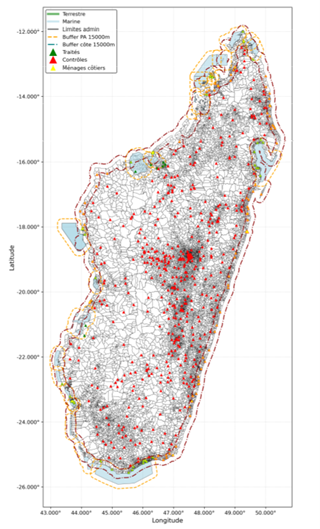
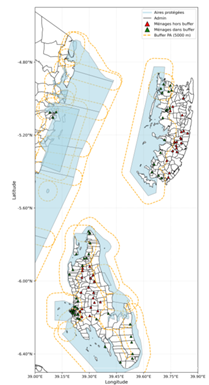
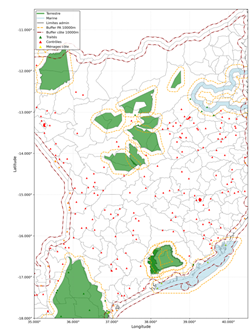
- Defined buffer zones around MPAs to distinguish “treated” households (potential beneficiaries) from “control” households (unexposed).
- Applied a quasi-experimental method (difference-in-differences) to isolate the impact of MPAs, controlling for selection biases (geographic, demographic, and climatic characteristics).
The analysis covers four countries with contrasting contexts:
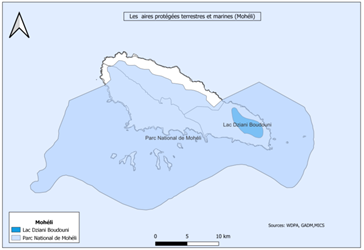
- Comoros: Study of Mohéli National Park.
- Madagascar: Extensive MPA network covering 1.38 million hectares.
- Tanzania (Zanzibar): Islands dependent on artisanal fishing.
- Mozambique (Cabo Delgado): Conflict-affected area with high dependence on marine resources.
Key results: Variable Effects Across Countries
| Country/Zone | Nutritional Health (Height-for-Age) | Household Wealth |
|---|---|---|
| Comoros | No significant effect | Negative impact (-0.19) |
| Madagascar | Significant improvement (+1.47) | Decline (-0,43) |
| Zanzibar | Deterioration (-0,45) | No significant effect |
| Mozambique | Marked decline (-0,72) | No significant effect |
Methodological Limitations: The Challenges of Evaluation
- Selection Bias: MPAs are often established in less degraded or wealthier areas, skewing comparisons (Kuempel et al., 2019; Albers & Ashworth, 2022).
- Imperfect Data: Irregular and incomplete DHS/MICS surveys (e.g., lack of GPS coordinates for Comoros in 1996 and 2000, missing enumeration zone names) limit the robustness of results.
- Geographic Heterogeneity: Local contexts (conflicts in Cabo Delgado, insularity in Zanzibar) make generalization difficult.
Conclusions and Recommendations
MPAs improve nutritional health in Madagascar due to fish stock regeneration but reduce household wealth in the short term (access restrictions, lack of compensation). In Zanzibar and Mozambique, nutritional costs outweigh benefits, highlighting the need for support mechanisms (alternative incomes, social safety nets).
The study calls for:
- Adapting MPAs to local contexts (co-management, community participation).
- Strengthening data to refine impact assessments.
A Thesis for Further Exploration
Evaluating the Impact of Conservation Policies in Low-Income Countries, with a Focus on Transdisciplinary Projects in the Southwestern Indian Ocean
Launched in November 2025, Karim Diallo’s PhD project contributes to the debate on the relationship between conservation policies (particularly protected areas) and socio-economic development in the Global South. It aims to analyze how conservation policies promote or hinder development by assessing their impacts on poverty, food security, climate resilience, and coastal, terrestrial, and marine ecosystems. Its originality lies in a transdisciplinary approach, integrating a holistic vision of coastal socio-ecosystems and close collaboration with local stakeholders. The focus is on the southwestern Indian Ocean through the BRIDGES-IMPACT project, which studies marine socio-ecological transformations and their influence on coastal resilience.
Biosketch

Karim Diallo holds a Bachelor’s degree in Agricultural and Environmental Economics from Norbert Zongo University (Koudougou, Burkina Faso) and a double Master’s degree in Economic Analysis and Development Project Analysis from the School of Economics at Clermont Auvergne University. He completed an internship in 2024 at the Faculty of Economics, University of Florence, where he worked on a research project on the impact of weather shocks on conflict prevalence in developing countries. In 2025, he interned at the Center for Environmental Economics in Montpellier (CEE-M), focusing on the impact of conservation policies on socio-economic development in low-income countries.
Socio-Economic Impact of MPAs: Insights from the Literature
MPAs generate contrasting effects depending on their design and management:
Benefits:
- Food Security: Well-managed MPAs increase fish stocks, improving community nutrition (Naidoo et al., 2019; Nowakowski et al., 2023; Desbureaux et al., 2024).
- Economic Diversification: Tourism can offset income losses (Pham, 2020), as seen in Costa Rica (Madrigal-Ballestero et al., 2017).
- Co-management: Community involvement enhances effectiveness (Fidler et al., 2022; Guidetti & Claudet, 2010).
- Socioeconomic and Institutional Well-being: Long-established, well-managed MPAs tend to improve economic, social, and institutional well-being (Ban et al., 2017, 2019; Albert et al., 2021; Desbureaux et al., 2024).
Costs:
- Access Restrictions: Artisanal fishers face immediate losses (Pike et al., 2024), especially if MPAs are imposed without consultation.
- Maintenance Costs: Costs vary with MPA size (Wilhelm et al., 2014).
- Inequalities: Benefits are unevenly distributed (Mascia et al., 2010), risking exclusion of the most vulnerable.
Key References:
- Naidoo et al. (2019): Tourism-focused protected areas improve household economic well-being and nutritional health of children under 5.
- Albers & Ashworth (2022): MPA effectiveness depends on integration into ecological and social networks.
- Nowakowski et al. (2023): Highly protected MPAs enhance biodiversity and local well-being, provided benefit-sharing mechanisms exist.
- Pike et al. (2024): In Zanzibar, alternative activities (tourism, seaweed farming) generate less income than traditional fishing.
Contact: karim.diallo@inrae.fr
Sources : Karim Diallo’s internship report (2025), BRIDGES-IMPACT, CEE-M.
More news News