Assessing the Vulnerability of Marine Species with Limited Data in Réunion Island and Mayotte
In Réunion and Mayotte, artisanal coastal fisheries harvest a wide variety of demersal1 and pelagic2 species. Yet biological and fisheries data remain scarce, making conventional stock assessment methods unsuitable.
This gap is especially concerning as fishing pressure and the effects of climate change intensify. To address it, Productivity–Susceptibility Analysis (PSA), a semi-quantitative3 tool designed for data-limited settings, is used to rank species’ vulnerability by combining information on their biology and exposure to fishing pressure.
During his internship within BRIDGES RESILIENCE, Mattéo Le Floch, supervised by Emmanuel Tessier (Marbec, Ifremer) and Lionel Pawlowski (Decod, Ifremer), developed an adaptation of PSA. Originally designed for temperate fisheries using trawls or nets, the method was adapted to a tropical, multi-taxon setting dominated by line fishing. He also standardized it to support rigorous comparisons between Réunion and Mayotte and its future use at other BRIDGES study sites.
His work provides a practical decision-support tool, tested on a broad range of species, to identify management and research priorities in a limited data context. It also highlights the most pressing knowledge gaps.
Adapting and Testing the Method for Réunion and Mayotte
The tool assesses species’ vulnerability across two dimensions:
- Productivity: a stock’s inherent capacity to replenish itself after exploitation.
- Susceptibility: a stock’s exposure to fishing pressure, taking into account measures that reduce the risk of overexploitation.
It draws on quantitative data (precise numerical values from biology and fisheries) and qualitative information (descriptive input, including local expertise) to assess 18 attributes: nine for productivity and nine for susceptibility. Attributes originally designed for net and trawl fisheries were replaced with criteria suited to line fishing and baited hooks. Two climate-related attributes were added, and cumulative pressures from commercial, recreational, traditional, and illegal fishing were taken into account.
To build a standardized prototype for Réunion and Mayotte, Mattéo Le Floch compiled a database of 468 species of importance to fisheries, culture, ecosystems, and/or tourism. Where biological data were missing, he developed a probabilistic framework using FishLife, an international statistical and phylogenetic model.
Finally, thresholds calibrated against locally documented IUCN conservation statuses divide the vulnerability scale into four practical categories, from low to very high. Each species can be assigned to a category, making the results directly usable by managers.
Results, Limitations, and Conclusions
Contrasting vulnerability profiles of different types
The results reveal marked differences among taxonomic groups:
- Elasmobranchs (sharks and rays) have the highest vulnerability profiles because of their very low productivity, characterized by slow growth and late maturity.
- Bony fish are vulnerable primarily because of their high exposure to fishing. For some slow-growing species, low productivity and high susceptibility contribute equally, making them highly vulnerable.
- Reef species, which make up most of the study, share high exposure to fishing and climate pressures. Their vulnerability varies according to their productivity.
- Pelagic species (large migratory species) show low vulnerability, consistent with their limited exposure to coastal fisheries.
Comparisons between territories
Vulnerability levels differ significantly between Réunion and Mayotte. This difference is driven entirely by susceptibility, reflecting local geomorphological and fisheries conditions, rather than by species biology, which the study cannot yet distinguish between sites. The relative ranking of species nevertheless remains similar across the two territories.
Limitations of the method
- Productivity is currently treated as the same in both territories because sufficient local biological data are unavailable. This limits comparisons between sites to differences in exposure, or susceptibility.
- Vulnerability thresholds calibrated against the conservation statuses of Réunion’s reef-associated bony fish are applied to other taxa and to Mayotte, which may bias the results.
- The Euclidean calculation of the vulnerability score can obscure biologically distinct risk profiles, such as low productivity versus high exposure.
- FishLife produces a productivity ranking consistent with life-history theory, but its consistency with local data varies by trait. This will require attention in future applications.
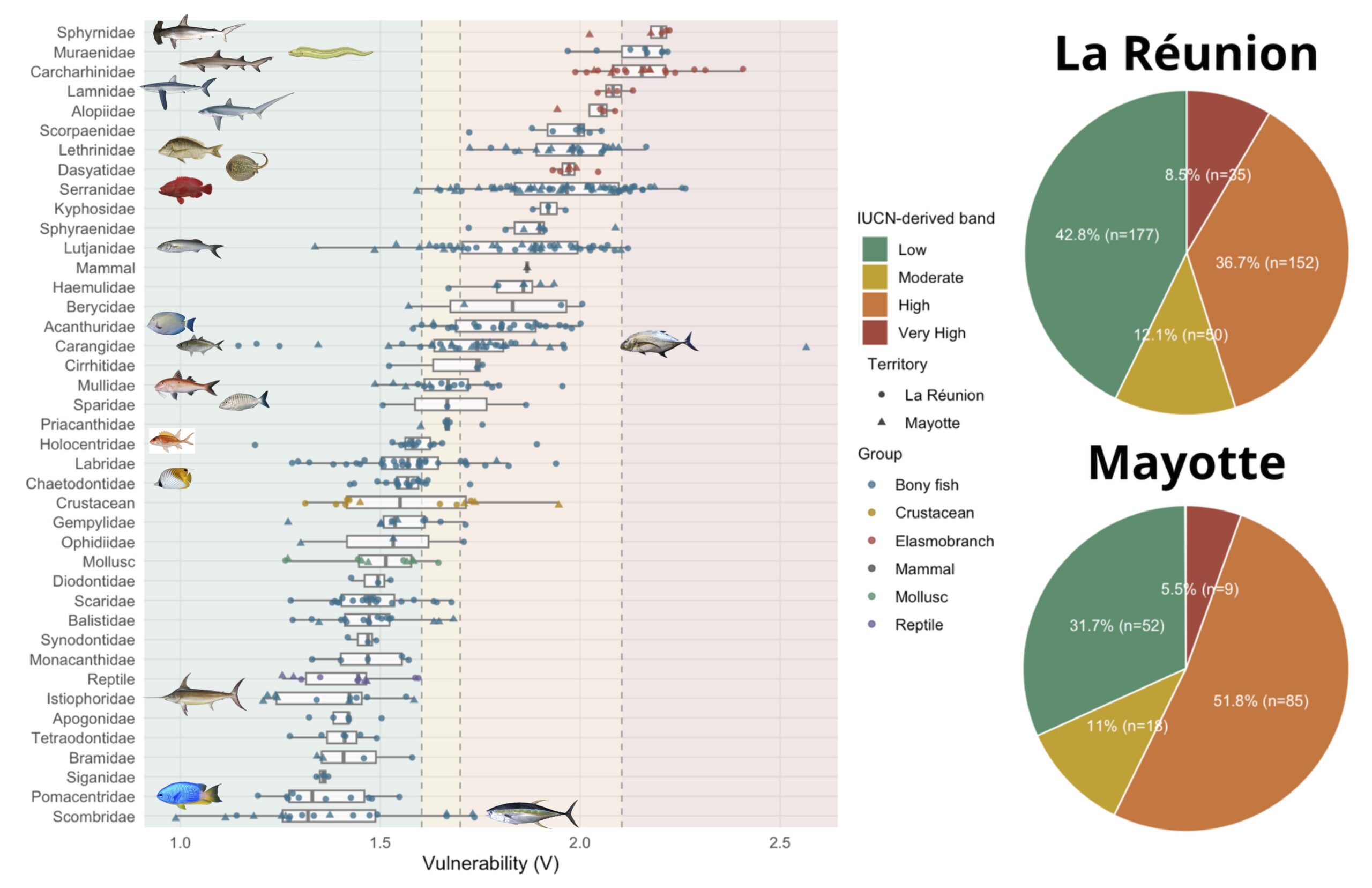
Figure 1. Variation in PSA vulnerability by family or taxonomic group, and the share of species in each vulnerability category by territory. Left: vulnerability by family or taxonomic group; point shape indicates territory. Shading and dashed lines show the selected vulnerability thresholds derived from IUCN categories. Right: share of species in each vulnerability category by territory.
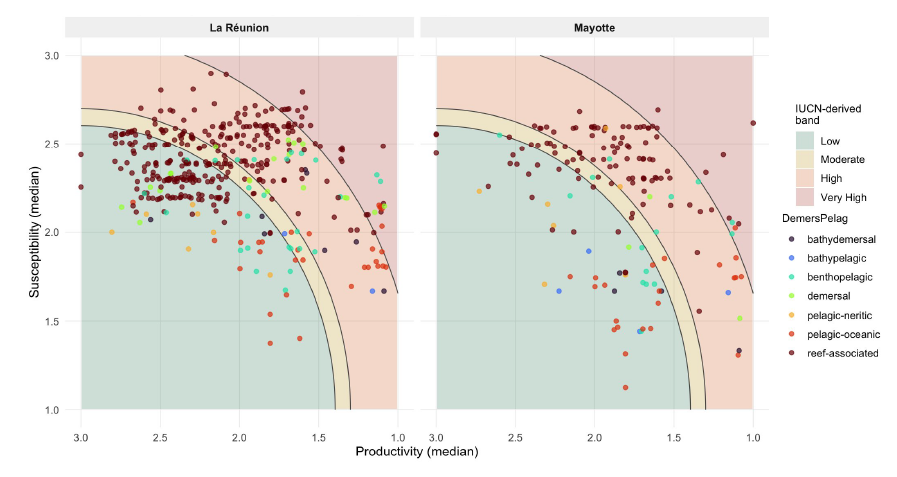
Figure 2. PSA vulnerability by territory and habitat use (DemersPelag variable in FishBase).
Looking ahead: perspectives
This study draws on an extensive review of PSA studies published since the original standardization by Patrick et al. (2009). It points to several ways to improve the tool:
- Document productivity locally. Although estimating growth parameters locally for all 468 species is impractical, a territory-specific adjustment could be developed from a representative sample of habitats and taxonomic groups. This would improve comparisons between sites.
- Test counterfactual management scenarios. Building on Baillargeon et al. (2020, 2026), Dee et al. (2019), and Kaniz Fatema et al. (2022), the tool could simulate how stronger regulations would affect vulnerability scores.
- Refine selected susceptibility attributes. These include catchability related to diet and exposure to illegal, recreational, and subsistence fishing, so that the assessment better reflects local conditions.
- Combine vulnerability with functional distinctiveness. As proposed by Laugier et al. (2025), a natural extension would be to examine how coastal fishing contributes to the loss of ecological functions in these island ecosystems.
Biosketch

Mattéo Le Floch graduated from Institut Agro Rennes-Angers. His experiences in Sri Lanka, Senegal, and the French Caribbean led him to study several tropical artisanal fisheries, including elasmobranch landings, the trade in large guitarfish, and dolphinfish fishing (link to the report produced by Mattéo). His work combines surveys of fishing communities, landing analyses, and biological data collection. Returning for the second year of a master’s degree in fisheries science, he specialized in statistics applied to fisheries and ecological modeling before completing his final internship with the BRIDGES RESILIENCE project.
In October 2026, he continues his work with BRIDGES through a PhD project entitled “MAYRUNFISH – Assessing Resources Vulnerability of Coastal Fisheries in a Data-Limited Context: Insights from the Western Indian Ocean,” supervised by Jean-Marc Fromentin, Emmanuel Tessier, Lionel Pawlowski, and Thomas Claverie.
Contact : matteo.lefloch@agrocampus-ouest.fr ; Matteo.Le.Floc.H@ifremer.fr
References
- Patrick, W. S., Spencer, P., Ormseth, O., Cope, J., Field, J., Kobayashi, D., Gedamke, T., Cortés, E., Bigelow, K., Overholtz, W., Link, J., & Lawson, P. (2009). Use of Productivity and Susceptibility Indices to Determine Stock Vulnerability, with Example Applications to Six U.S. Fisheries.
- Baillargeon, G. A., Tlusty, M. F., Dougherty, E. T., & Rhyne, A. L. (2020). Improving the productivity-susceptibility analysis to assess data-limited fisheries. Marine Ecology Progress Series, 644, 143–156. https://doi.org/10.3354/meps13362
- Baillargeon, G. A., Wynn, A. A., Baldisimo, J. G. P., Tlusty, M. F., & Rhyne, A. L. (2026). Evaluating species at risk in data-limited fisheries: A productivity–susceptibility analysis for marine aquarium fish. Ecological Applications, 36(4), e70272. https://doi.org/10.1002/eap.70272
- Dee, L., Karr, K., Landesberg, C., & Thornhill, D. (2019). Assessing Vulnerability of Fish in the U.S. Marine Aquarium Trade. Frontiers in Marine Science, 5. https://doi.org/10.3389/fmars.2018.00527
- Kaniz Fatema, U., Faruque, H., Salam, M., & Matsuda, H. (2022). Vulnerability Assessment of Target Shrimps and Bycatch Species from Industrial Shrimp Trawl Fishery in the Bay of Bengal, Bangladesh. Sustainability, 14, 1691. https://doi.org/10.3390/su14031691
- Laugier, C., Roos, D., Belloeil, P., Mahé, K., Nithard, A., Rungassamy, T., Pelletier, D., Tessier, E., Trindade-Santos, I., Robert, M., Leprieur, F., McLean, M., Albouy, C., & Auber, A. (2025). A conservation priority index to rank fish species within IUCN Red List categories: A case study of marine fishes from Réunion Island. Global Ecology and Conservation, 62, e03750. https://doi.org/10.1016/j.gecco.2025.e03750
- Species living near the seafloor and feeding from it. ↩︎
- Species living in waters near the surface. ↩︎
- A semi-quantitative tool provides an approximate magnitude, relative estimate, or score on a defined scale rather than an exact absolute value. ↩︎
More news News